Must-See Bavaria · Franconia
Bamberg: A Day in Bavaria's Little Venice
Personally visited by Martin · 6 April 2022
Half-timbered streets, riverside houses, and my first taste of Bamberg's famous smoked beer
I'd had Bamberg on my list for a while. UNESCO old town, a cathedral, a river running straight through the middle of it. What finally got me on the train was realizing I didn't need a car, or even much of a plan. Just the regional ticket and a transfer in Nuremberg.
Getting there, and getting started
From Munich, there's a direct ICE that gets you to Bamberg in under two hours. It's not covered by the Bayern-Ticket or the Deutschland-Ticket though, and fares vary a lot depending on when you book. The budget route is the one I took: a Regional-Express from Munich to Nuremberg on the high-speed line (about 1h45, running roughly every two hours), then a short change onto a regional train to Bamberg (another 40 minutes or so). All in, you're looking at closer to three hours each way, so with the return trip this is a full, long day out, not a casual half-day. I'd budget 7–8 hours in Bamberg itself if you want to sit down somewhere rather than just tick off the sights.
From Bamberg's station, the old town is about a 20–25 minute walk, flat and easy, or you can hop on a city bus right outside the station if you'd rather save your legs for later.
Haki tip: If you're going on a weekday, remember the Bayern-Ticket only kicks in at 9:00; on weekends it's valid from midnight. I left early, and on a weekday that would have meant buying a normal ticket for the first leg or switching to the Deutschland-Ticket, which has no weekday morning restriction.
Into the old town
Just an ordinary cobbled street to start with. Half-timbered houses leaning slightly into each other, a tower somewhere above the rooftops. One of the first things I did was duck into Obere Pfarre, Bamberg's Church of Our Lady. Its tower, topped with a gilded statue of the Madonna, is visible from most of the old town. Inside it opens up into a bright, almost theatrical Rococo nave: white-and-gold stucco, painted ceiling medallions, an altar dripping with gilding. One side chapel was under restoration netting when I was there, which didn't take anything away from it.
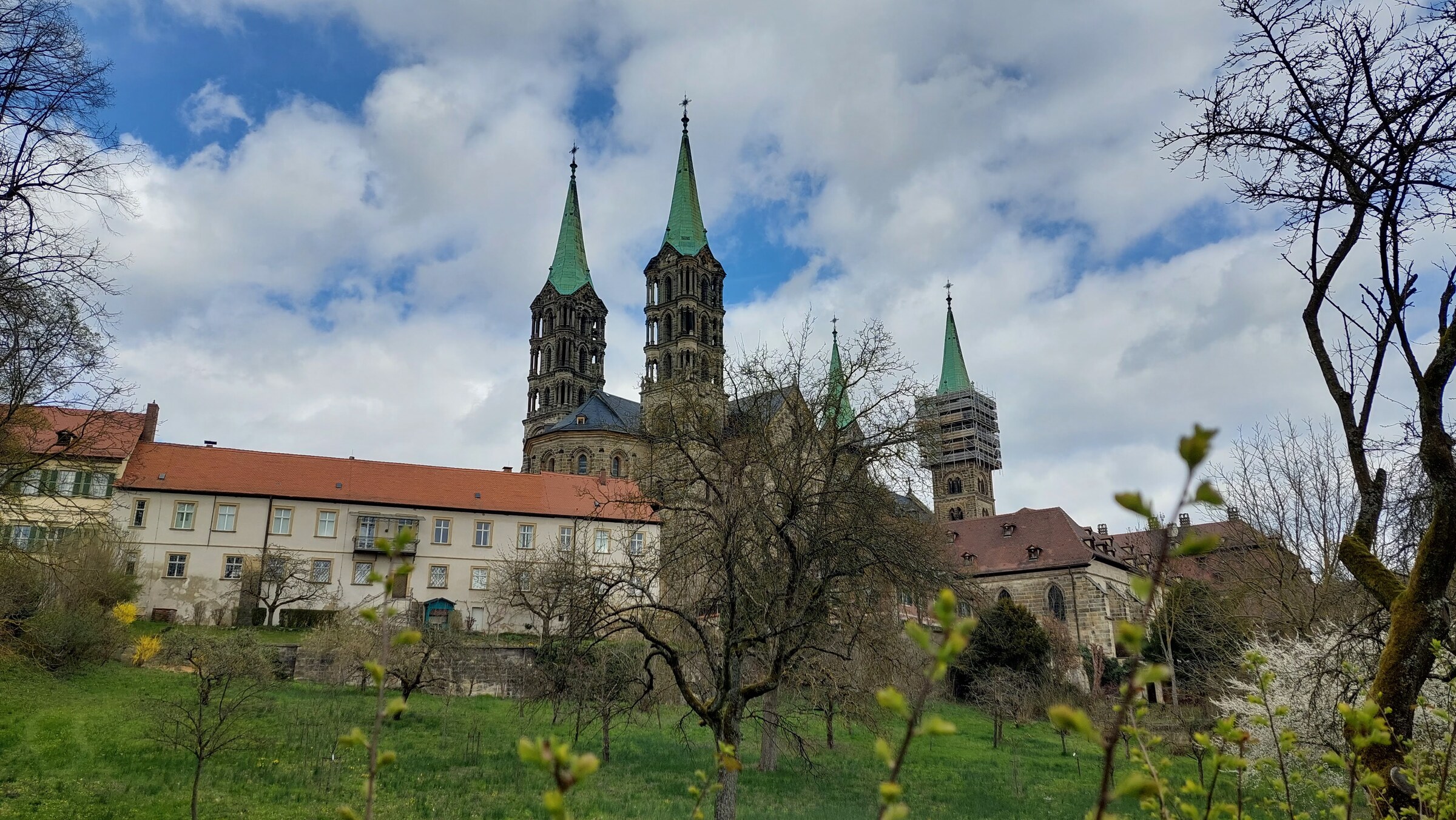
From there it's a short walk up to Domplatz, where the cathedral (the Bamberger Dom, with its four distinctive spires) sits next to the Alte Hofhaltung, the old bishops' court with its timber-framed courtyard. One of the towers, unfortunately, had scaffolding on it when I was there, still being worked on after a thousand years.
The Rose Garden, and the view that makes the detour worth it
Behind the Neue Residenz, the newer of Bamberg's two prince-bishop residences, there's a rose garden that costs nothing to visit, even though the Residenz itself charges around €7 for entry (I didn't go in myself, as a small renovation was underway at the time). Early April meant bare rosebushes and trimmed box hedges rather than anything in bloom. The terrace at the far end is where it pays off, though: the whole old town opens up below, a sea of red-tiled roofs with the cathedral behind you.
Afterward I went into the Dom itself: the nave, one of its historic tombs, and the candlelit crypt, which dates back to around 1200 and is the oldest surviving part of the current building. The cathedral also holds the tomb of Pope Clement II, the only pope buried north of the Alps, though his tomb is in the western choir rather than the crypt. The crypt itself holds other historic burials, plus a reliquary shrine inscribed with a line from Psalm 149. I couldn't pin down exactly whose it is, so it's likely a shared shrine for more than one saint's relics rather than a single named tomb.
The water
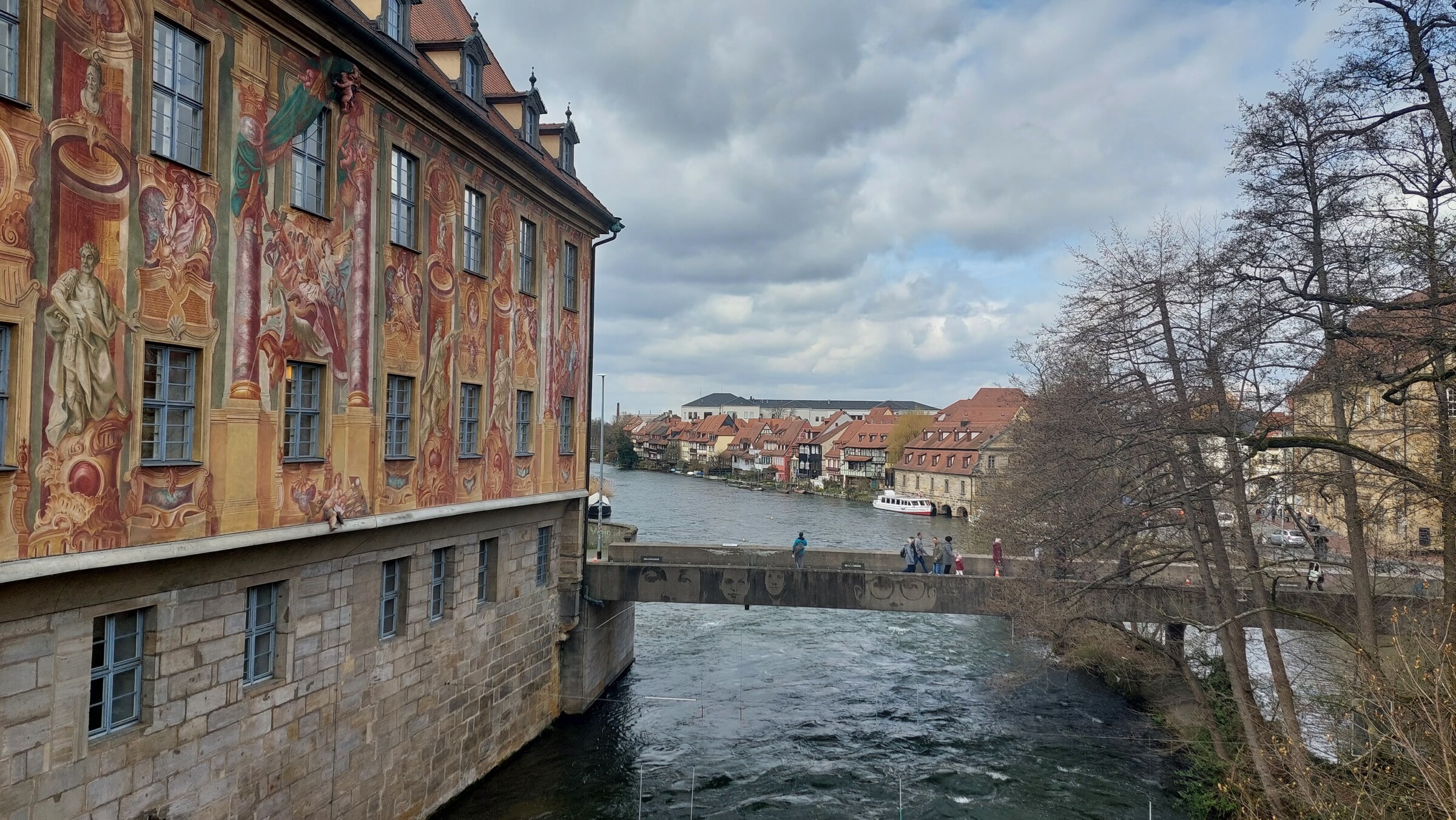
From the hill, everything slopes back down toward the Regnitz, and this is where Bamberg earns its nickname. The Altes Rathaus, the old town hall, is built on an island in the middle of the river. It's reachable only by two bridges, and faded frescoes still cover its facade.
A few minutes downstream is Klein-Venedig, Little Venice: a row of former fishermen's cottages leaning right over the water, flower boxes on the windowsills, boats tied up below. I stood on the bridge there longer than I meant to. The view down the row of houses is one of the best in the old town. Just past it, a weir sends the river into a proper white rush, loud enough to hear before you see it.
Haki tip: If you'd rather see it from the water than above it, you've got two options. Personenschifffahrt Kropf runs a proper sightseeing boat: about 80 minutes round trip from the "Am Kranen" landing, past Klein-Venedig, the harbour, and ERBA-Park, €14 for adults and €7 for kids. Or there's the smaller, more romantic option: gondola rides from the Alter Kanal under the Obere Brücke, around €60 for 30 minutes for up to six people, so worth splitting if you're not travelling solo. I didn't book either one myself, but both are on my list for next time.
On the way back up toward Grüner Markt, I stopped into one more church: St. Martin's, Bamberg's only fully Baroque church, tucked right onto the market square. Its ceiling isn't a real dome; it's a flat surface painted in perspective to look like one. Above the altar sits the monogram IHS, the Jesuit order's mark, since the church was built by the Jesuits in the 17th century.
Rauchbier: Bamberg's famous smoked beer
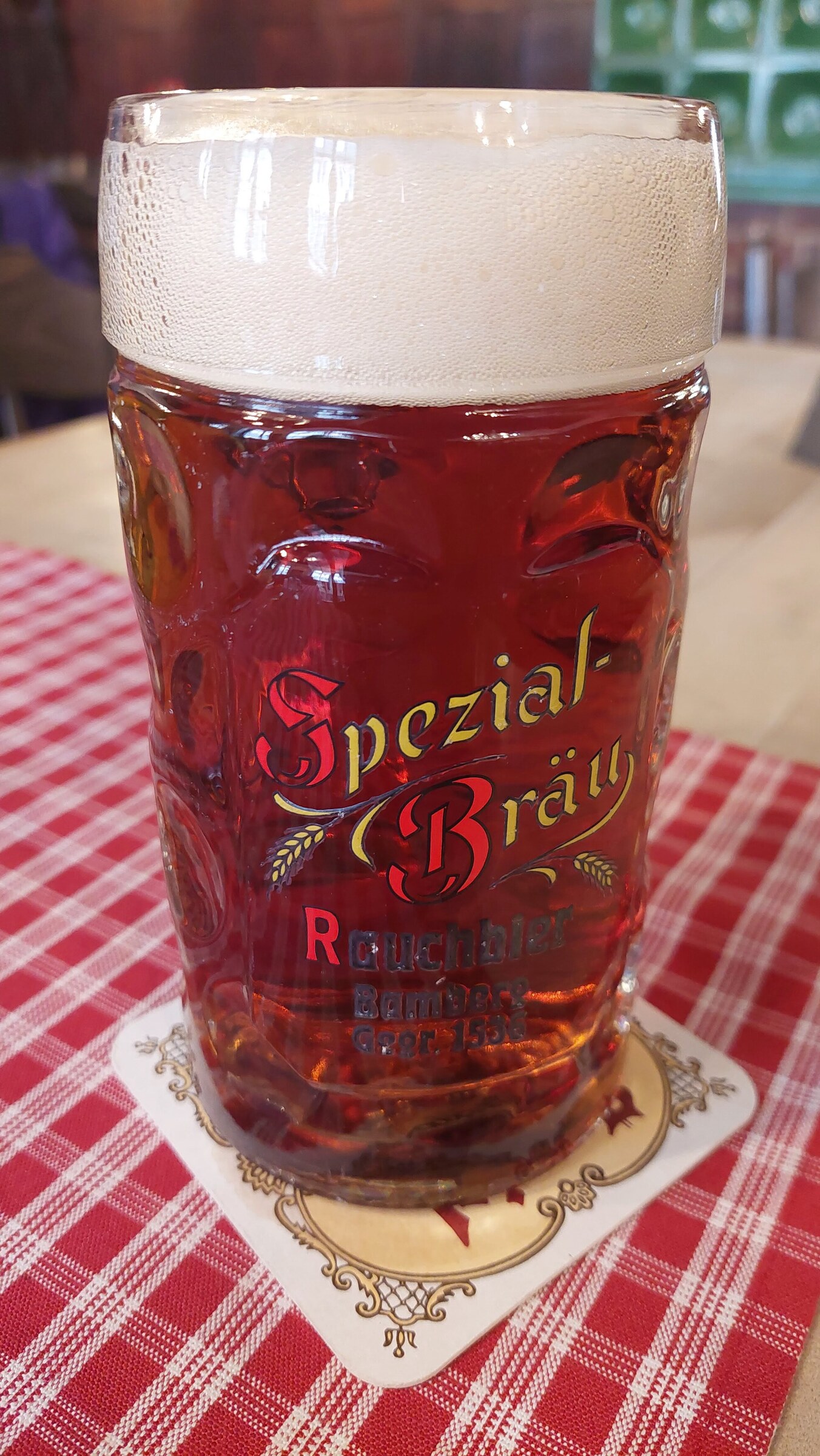
Bamberg's other claim to fame is its smoked beer. Up until the 19th century, more or less all beer had some smokiness to it, because the malt was dried over open wood fires. Once cleaner drying methods took over, that flavour mostly disappeared from German beer, except in Bamberg. Two breweries there, Schlenkerla and Spezial, kept doing it the old way, each with its own method, which is why the two taste noticeably different from each other.
Mine came from Spezial: their Lager, 4.9%, smoked over a beechwood fire in the brewery's own malthouse (it's been in the Merz family since 1898, now running its fourth generation). It was my first time trying smoked beer at all. I found the first sip surprising. I had to give it a little time. But if smoky beer isn't your thing, that's fine too.
On the way back
It drizzled on and off through the morning and cleared up by early afternoon. Nothing that needed more than a light rain jacket, so don't let a grey forecast put you off. On the way back toward Nuremberg, a rainbow showed up over a stretch of solar panels outside the city, a small unexpected bonus to end the day. The train back was packed; clearly I wasn't the only one who'd picked Bamberg for a day out.
Photos from the day
All shot by me on the visit. Swipe through.
The Regnitz runs right through town, so you cross it more than once on the walk in.
1 / 20Useful links
- Deutsche Bahn journey planner — plan your route
- Deutschland-Ticket — flat monthly ticket
- Bayern-Ticket — regional day ticket
- Neue Residenz Bamberg — opening times & entry fee
- Personenschifffahrt Kropf — sightseeing boat (German-only site)
- Gondola rides (Bamberger Gondoletta) — romantic boat alternative (German-only site)
- Bamberg Tourismus — official city tourism site
Take it with you
Download the day itinerary for offline use, or buy me a train ticket if this guide saved you time.
 Buy me a train ticket
Quick facts
- From Munich
- ~3h by train (change in Nuremberg)
- Getting into town
- ~20–25 min walk from the station, or city bus
- Ticket
- Bayern-Ticket (weekdays from 9:00) or Deutschland-Ticket
- Best season
- Spring (blossoms) or early autumn (foliage colours)
- Budget
- Free to walk · Neue Residenz €7 · boat tours from €14
- Signature taste
- Rauchbier at the Spezial brewery
Where it is
Bamberg, Upper Franconia
Weather
Full forecastWalk DNA
- Distance
- ~8–9 km total (round trip from the station, plus wandering the old town)
- Duration
- ~3 hours of walking
- Elevation gain
- ~20–30 m (one gentle climb up to Domplatz/the Residenz hill)
- Terrain
- cobblestones, flat old town with one moderate hill
- Difficulty
- Easy
Beer DNA
- Beer
- Spezial "Lager", their best-known smoked beer
- Brewery
- Spezial, Bamberg, first recorded 1536
- ABV
- 4.9%
- Colour
- pale amber to light brown
- Smoke
- smooth and mild, noticeably gentler than Schlenkerla's stronger, more assertive smoke
- Bitterness
- low to medium, full body
- Haki's note
- This is an acquired taste, and the smokiness won't be for everyone. Go in with an open mind, and don't expect a normal lager.
New trips, straight to your inbox
No spam. Just the routes, how to get there by train, and the best time to go.
By subscribing, you agree to receive the Haki Travels newsletter. We'll send you one email to confirm your subscription, and you can unsubscribe at any time. Privacy Policy