Bavaria Wanderlust · The Alps & Zugspitze
Zugspitze: How I Got to the Top of Germany Without Really Hiking at All
Personally visited by Martin · 15 September 2025
Two visits, six months apart — one buried in March snow, one packed with September crowds. Here's how to get from Munich to Germany's highest point by train and cable car, why I never made it to the actual summit cross, and why you should build in more time than you think you need.
Two very different days on the same mountain
I've been up the Zugspitze twice now — once in March, with snow piled so high the huts looked half-buried, and once in September, on a clear day when it felt like half of Bavaria had the same idea I did. Same mountain, same route, completely different experience both times. That contrast is honestly the best reason I can give you to read this before you go: what you'll find up there depends enormously on when you show up.
Neither of my visits involved much actual hiking, by the way. The Zugspitze is Germany's highest peak at 2,962 meters, and most visitors ride up — a cogwheel train, then a cable car, and you're standing at nearly 3,000 meters without breaking a sweat. That's not a shortcut or a cop-out — it's simply how most people enjoy this mountain. But it's not the only way: on both visits, especially the September one with good weather, I saw dozens of hikers coming up on foot, so if you'd rather earn the view, there's a real route for that too — more on it further down. Either way, plan around the two things that actually matter here: timing your visit around the weather, and being ready for the crowds.
Getting there: the train from Munich
I went on a weekday both times, catching the 07:29 regional train from Munich Hauptbahnhof, covered by my Deutschlandticket — no need to buy anything extra for that leg. Budget around 1.5 hours for the ride. It's a comfortable one through increasingly dramatic scenery as the Alps start closing in around the tracks.
If you don't already have a Deutschlandticket, a Bayern-Ticket is the other option — but if you're going on a weekday and want an early start like I did, know that the Bayern-Ticket only becomes valid at 9:00 a.m. on weekdays (it's valid from midnight on weekends and public holidays). An early train like mine wouldn't be covered by it on a weekday, so you'd need the Deutschlandticket or a normal fare for that leg instead. Either way, a single Munich–Garmisch fare without one of these tickets adds up fast, especially traveling as a group.
This is a genuinely popular destination, so don't cut your connection times close — get to the platform at least 15–20 minutes before departure and expect a proper crowd, especially on a clear day.
One small but genuinely useful thing: there are free toilets right at the Zugspitzbahn's own station in Garmisch. After a 1.5-hour train ride, if the toilet on board wasn't working (it happens), that little wait for your connecting train is a good moment to make use of them.
Up the mountain: the cogwheel train
From Garmisch, the Bayerische Zugspitzbahn — the cogwheel train — takes you most of the way up. Budget close to an hour for this leg, maybe a little more; it's not a quick hop. But it's a genuinely beautiful ride, climbing steadily through forest and then above the treeline, with the views opening up more with every bend. I never found it boring, even the second time.
One thing worth knowing while you're sitting on it: this is officially Germany's highest railway line, climbing all the way to 2,650 meters before you switch to the cable car for the final stretch.
The train itself runs at least every half hour, more often when it's busy — but leave yourself real time before your planned departure. The Zugspitzbahn's own station in Garmisch is a separate walk from the main Garmisch-Partenkirchen train station, and the first time I went, by the time I'd walked over and bought my ticket at the counter, my train had already left — the next one wasn't for another half hour. Buy your ticket online in advance if you can, or at least budget extra time for the walk and the ticket line.
If you care about the view on the way up, try to sit on the right-hand side of the train — that's where the better window views were, in my experience. Just don't count on keeping that seat the whole way: some services change trains at Eibsee partway up, and if it's crowded, you may end up standing rather than picking your side, which is exactly what happened to me on my second visit.
Check the current timetables directly on the Zugspitzbahn's own website before you go (see Useful Links below). As of the 2026 season, a standard adult round-trip (train and cable car combined, one ascent + one descent) costs €78, with a one-way option at €46. Youths (16–18) pay €62.50 return / €37 one-way, children (6–15) pay €39 return / €23 one-way, and there's a discounted family rate for children traveling with a parent. It's the same combined ticket whether you're taking the train, the cable car, or mixing both directions — always double-check current prices before you go, since these do change season to season.
The summit: Germany and Austria, and a lot of wind
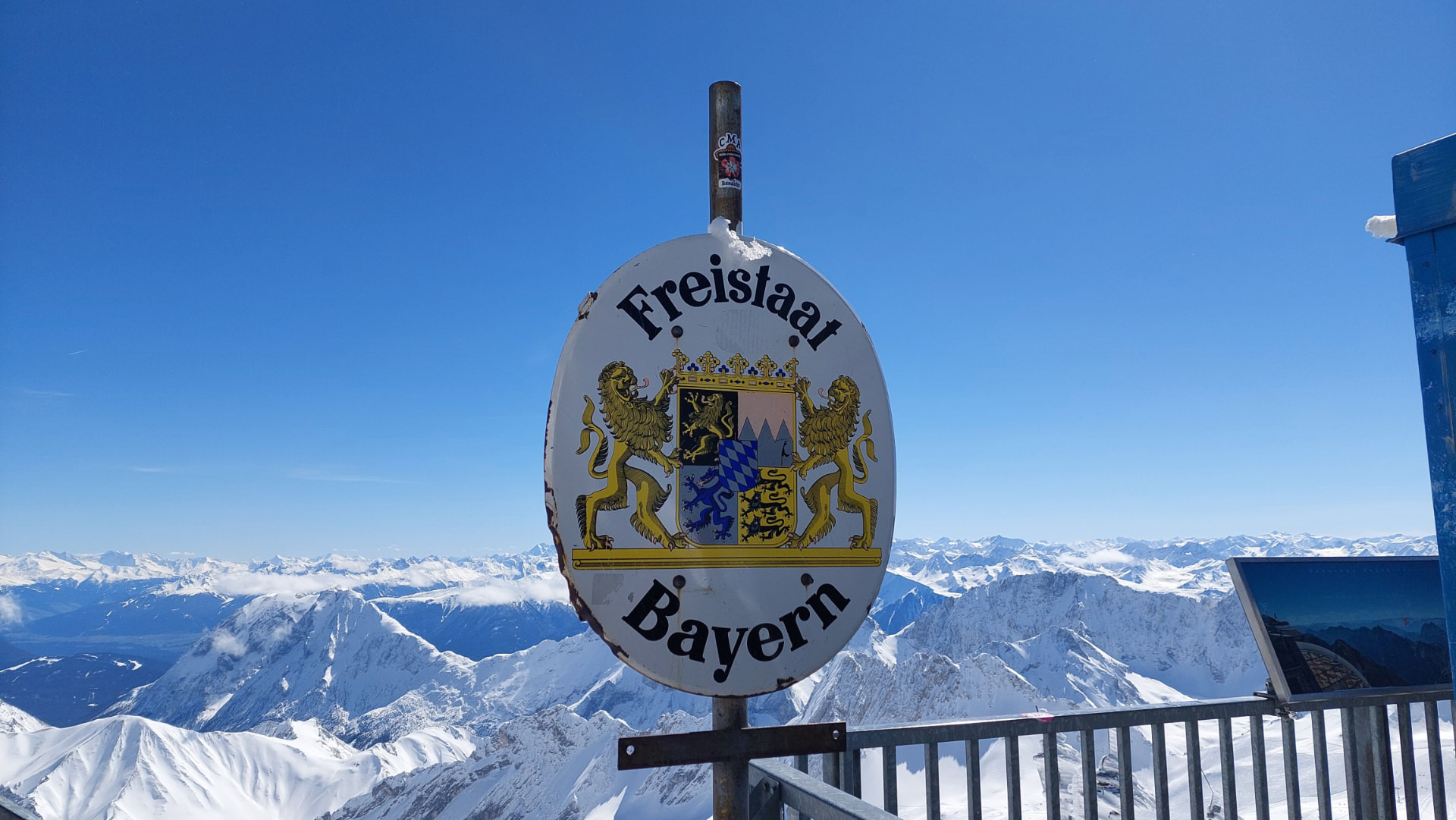
At the top, the mountain splits — literally. Germany and Austria share the summit, connected by a narrow walkway, each side with its own terrace and its own view. It is windy up there. Properly windy, in a way that photos never quite capture — bring a layer you can zip up even on a warm day down in the valley.
I'll be honest about one thing: I never made it to the actual golden summit cross, on either visit. Getting to it means a short scramble up chains and ladders bolted into the rock, and on my September visit the queue for it was long enough that I decided the view from where I was standing was good enough. If reaching the cross itself matters to you, get there early — the line only grows as the day goes on.
Sonn Alpin: the glacier, a little chapel, and lunch on the terrace
Before heading back down for good, I dropped down to Sonn Alpin — the mid-station on the Zugspitzplatt, where Germany's only glacier is right there in front of you. There's a small chapel here too, easy to miss if you're rushing between cable cars, worth the two minutes it takes to step inside.
This is also where I had lunch both times: goulash, a pretzel, and a beer on the terrace, looking straight across at the glacier. It's not fine dining, but it might be the highest-altitude goulash I've ever eaten.
Worth knowing about the ticket here: between the summit and Sonn Alpin, you can ride the connecting Gletscherbahn cable car up and down as many times as you like on the same combined ticket — it's only the "big" leg, the cogwheel train up from Garmisch and the cable car down to Eibsee (or vice versa), that's limited to one ascent and one descent each. That's exactly how I could drop down for lunch and head back up again without buying anything extra.
The area around Sonn Alpin is worth lingering in, too, and it looks completely different depending on the season. In March, there was still enough snow for people to go sledding, or just slide down on a flattened plastic bag if they didn't have a proper sled — kids and adults both. Plenty of people were still skiing on the surrounding slopes, too. In September, the same open slopes were full of people sunbathing and chilling out with a beer or a mixed drink, in no hurry to go anywhere. Either way, it's less of a "quick stop" and more of a place to actually sit down for a while before heading back up.
Then it was back up to the summit one more time before starting the descent properly.
Down to Eibsee, and in for a swim
From the top, I took the cable car straight down to Eibsee — the turquoise lake sitting right at the mountain's foot. On my September visit, I couldn't resist taking my shoes off and wading in — plenty of other people were properly swimming, not just paddling. It's one of the most beautiful spots in the whole area, and if you have any time buffer left in your day, it's worth spending some of it right here rather than rushing straight to the train.
Getting back: budget more time than you think
Here's the one thing I'd tell anyone before they go: build in generous time buffers, especially if you're visiting on a nice-weather day. On my September visit, the little train from Eibsee back to Garmisch was so full I barely squeezed on. On a clear day, everyone on the mountain is trying to get down around the same time you are — don't plan your connections in Munich too tightly around it. My own return train left Garmisch at 18:05 and got me back into Munich Hauptbahnhof at 19:26 — use that as a rough benchmark, but give yourself more margin than I did if you can.
If you'd rather hike it
Riding up isn't the only option. On a clear day, plenty of people hike to the summit under their own power — I watched dozens go past on foot on my September visit. The classic route is the Reintal trail from Garmisch: just under 22 km one way with about 2,250 m of elevation gain, rated T2 (easy hiking trail) for the first stretch up through the Partnach Gorge to Reintalangerhütte, then steeper and more technical from there past Knorrhütte and across the Zugspitzplatt, finishing with a short via-ferrata-style section on the final approach to the summit. Most people treat it as a two-day tour with an overnight stop at Reintalangerhütte or Knorrhütte rather than a single push. If you'd rather skip that last exposed stretch, you can join the cable car for just the final 400 m of elevation instead of climbing it.
This isn't a route to improvise — check current conditions and hut availability before you commit, and don't attempt the via ferrata section without the right gear and experience.
Good weather on the Zugspitze is a mixed blessing — the views are unbeatable, but so are the queues, for the cable cars, the cogwheel train, and the summit cross alike. If your schedule allows it, go early, and always build in more time than the official journey times suggest. You will need it.
Photos from the day
All shot by me on the visit. Swipe through.
Eibsee in September — the water is genuinely this turquoise, and yes, people do swim in it. This is the starting point for the whole Zugspitze trip, whichever way up you choose.
1 / 24Useful links
- Deutsche Bahn — journey planner — look up train connections and current times
- Deutschland-Ticket — covers this whole trip on a flat monthly price
- Bayern-Ticket — for day-trippers — only valid from 9:00 a.m. on weekdays
- Bayerische Zugspitzbahn — official site — cogwheel train and cable car operator, general info
- Timetables & operating hours — check current departure times before you go
- Tickets & prices — current fares for the combined train + cable car ticket
- Sonnalpin glacier restaurant — check the menu before you go
Worth the hype? Yes
Worth the hype — but treat it as a full-day trip built around the view and the weather, not a quick stop. Go on a day with a good forecast, expect crowds, and leave time for Sonn Alpin and Eibsee, not just the summit itself.
Haki alternative: If you'd rather skip the cable-car crowds, go outside peak season (March/April still has snow) or hike up via the Reintal trail instead — see the section further up in the article.
Take it with you
Download the day itinerary for offline use, or buy me a train ticket if this guide saved you time.
Quick facts
- Region
- The Alps & Zugspitze
- Access
- 1 h 30 min by train to Garmisch, then the cogwheel train (about 1 h) or the cable car up the mountain
- Distance
- 90 km from Munich
- Cost
- €€€
- Best months
- Year-round — ski season Dec–Apr, hiking and sightseeing May–Oct
- Crowds
- high crowds (my assessment)
Where it is
Grainau / Garmisch-Partenkirchen
The Deutschlandticket covers the whole trip. If you're using a Bayern-Ticket instead, it's only valid from 9:00 a.m. on weekdays (midnight on weekends/holidays).
Weather
Full forecastHaki Score
8.5Hike DNA
- Distance
- ~0.5 km on foot around the summit and Sonn Alpin — the mountain itself is climbed by train and cable car
- Elevation gain
- ~20 m on foot (the mechanized ascent isn't counted in this number)
- Time
- Full day from Munich; the cogwheel train ride alone takes about 1 h
- Difficulty
- Very easy — flat walking around the summit platforms and Sonn Alpin, no technical terrain
- Crowds
- High, especially on clear-weather weekdays and weekends alike
- Family-friendly
- Yes
- Dog-friendly
- Yes, on a leash — combined €6 surcharge for train + cable car, no muzzle required
More in The Alps & Zugspitze
Karwendelbahn: Germany's Highest Cable Car, Its Own Brewery, and a Trail Full of Sheep
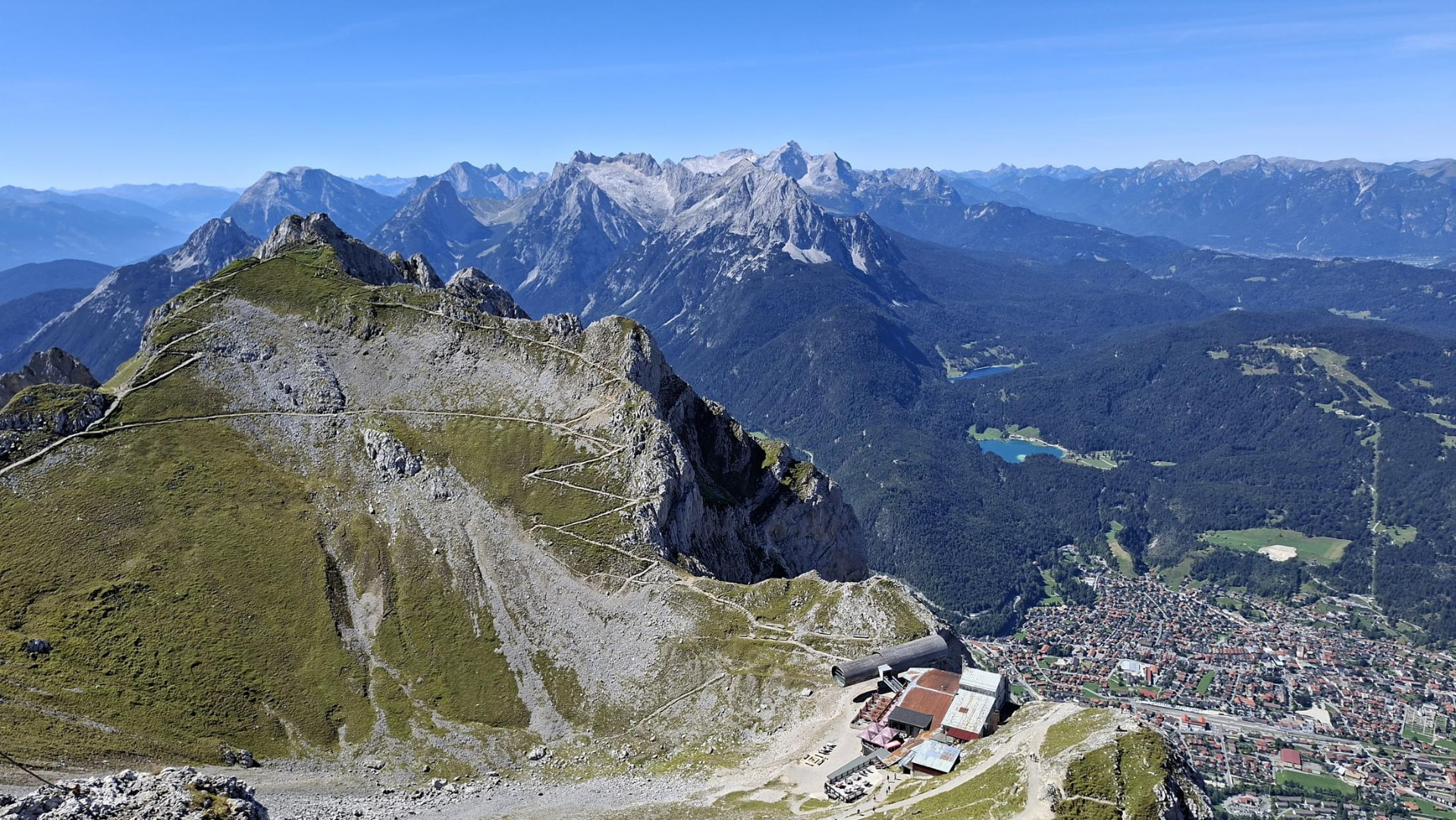
The first time I rode up the Karwendelbahn, fog swallowed the summit whole — I could hear the wind and not much else. This time I waited for a clear forecast instead, and it turned out patience was the only thing I'd been missing. From the top terrace, the Wetterstein range lines up on one side and the Austrian Karwendel on the other, and somewhere in between, a herd of sheep has the best view in Bavaria and doesn't care who knows it.
Rotwand from Spitzingsee: Up on Foot, Down by Cable Car, and a Käsespätzle in Between
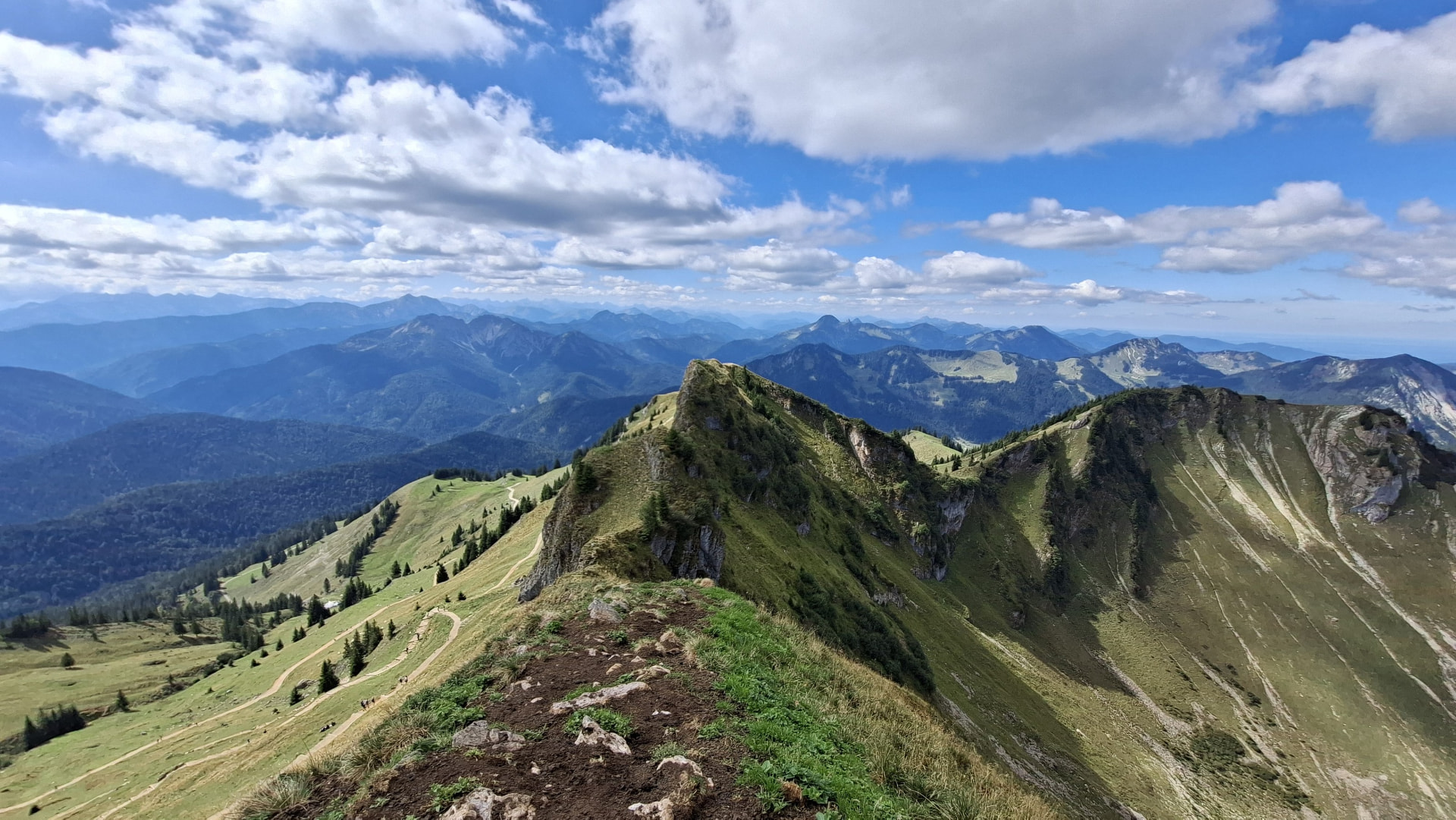
The sign at the trailhead doesn't waste words: alpine experience, sure-footedness, and a head for heights required. I read it, shrugged, and kept walking — and by the time I was holding a steel cable over slick rock below Taubenstein, with families ahead of me deciding whether to turn back, I understood why the German Alpine Club bothers putting signs like that up at all. The ridge past it, all the way to Rotwand's 1,884 m summit, is the reason to come. The Käsespätzle and the cable car down are the reason it doesn't hurt to stay a while first.
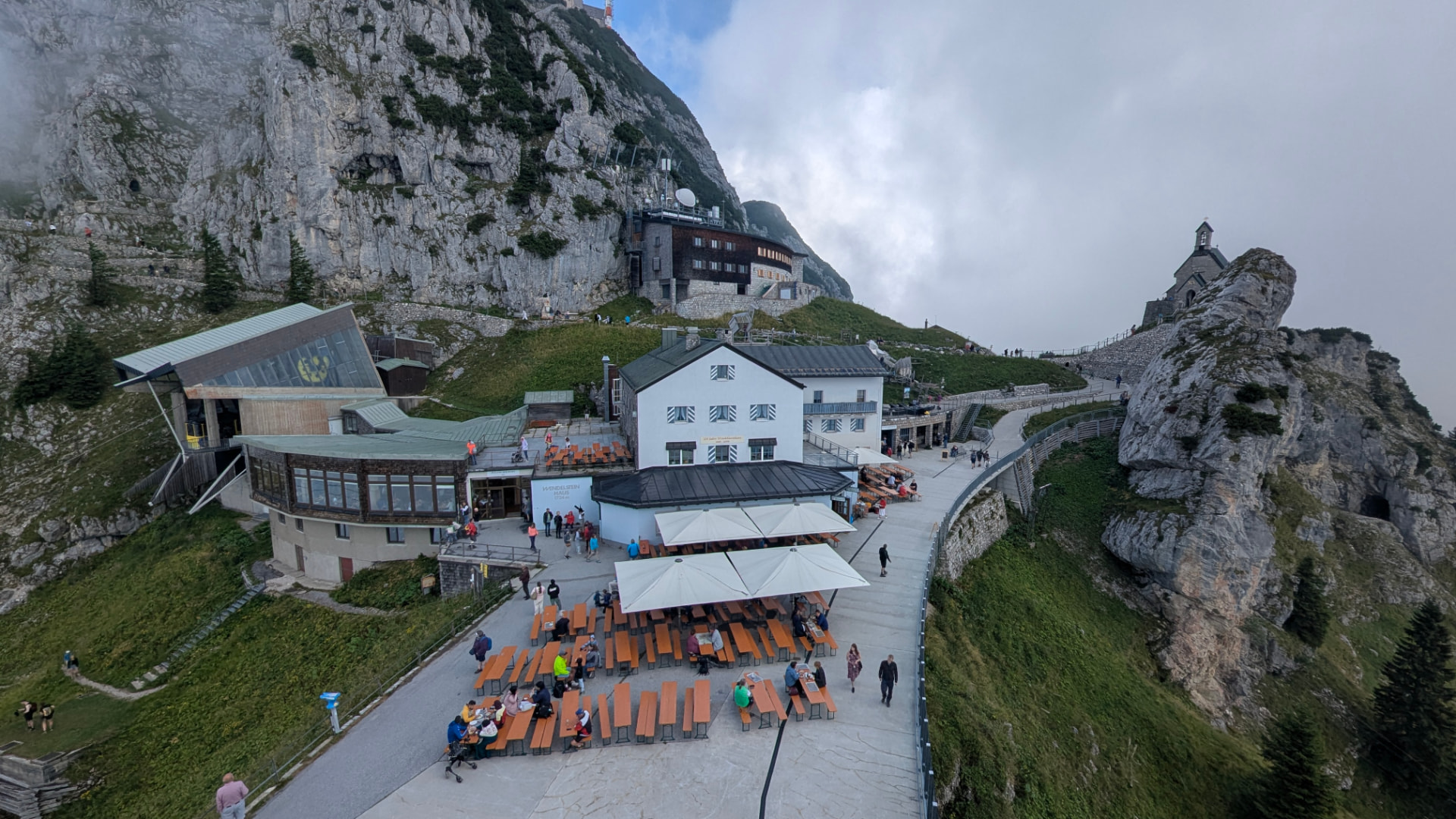
Wendelstein: A Real Alpine Hike, One Train Ride from Munich
I climbed Wendelstein expecting a quiet alpine trail and found a mountain with its own church, cave, restaurant terrace, and university observatory waiting at the top — plus a cable car and a 114-year-old rack railway — the oldest still-working one in Bavaria — in case my legs gave out first. They didn't, but it was close: the official signs say 3.5 hours up, and I did it in 2.5.
New trips, straight to your inbox
No spam. Just the routes, how to get there by train, and the best time to go.
By subscribing, you agree to receive the Haki Travels newsletter. We'll send you one email to confirm your subscription, and you can unsubscribe at any time. Privacy Policy