Bavaria Wanderlust · The Alps & Zugspitze
Why Mittenwald Deserves More Than a Quick Stop
Personally visited by Martin · 4 September 2026
Coming down from the Karwendelbahn into Mittenwald, I planned to grab a local beer at the station kiosk — it was already closed, and a twenty-minute Edeka detour later I ended up with a Radler. That single mistake taught me Mittenwald deserves more time than a quick train-stop wander.
The kiosk, the tracks, and no local beer
Coming down from the Karwendelbahn around 4pm, I figured I'd grab a cold drink at the station kiosk before walking into the village — it closes at 5, and by the time I remembered, I was deep in the center with a train to catch. Edeka sits right across the tracks, close enough to see, except crossing them isn't allowed, so "right there" turned into a twenty-minute detour at a brisk pace. Inside: no local Mittenwald beer, just the standard Munich lagers, so I settled for a Radler. Lesson learned — if the station kiosk happens to be open, that's usually where the local beer actually is; Edeka won't have it.
Haki tip: If you want an actual Mittenwald beer, don't count on Edeka — it's just standard Munich lagers, and getting there means an awkward walk-around since you can't cross the tracks directly. The station kiosk, when it's open (before 5pm), is usually your best and only shot at something local.
A small park and a bigger church than expected
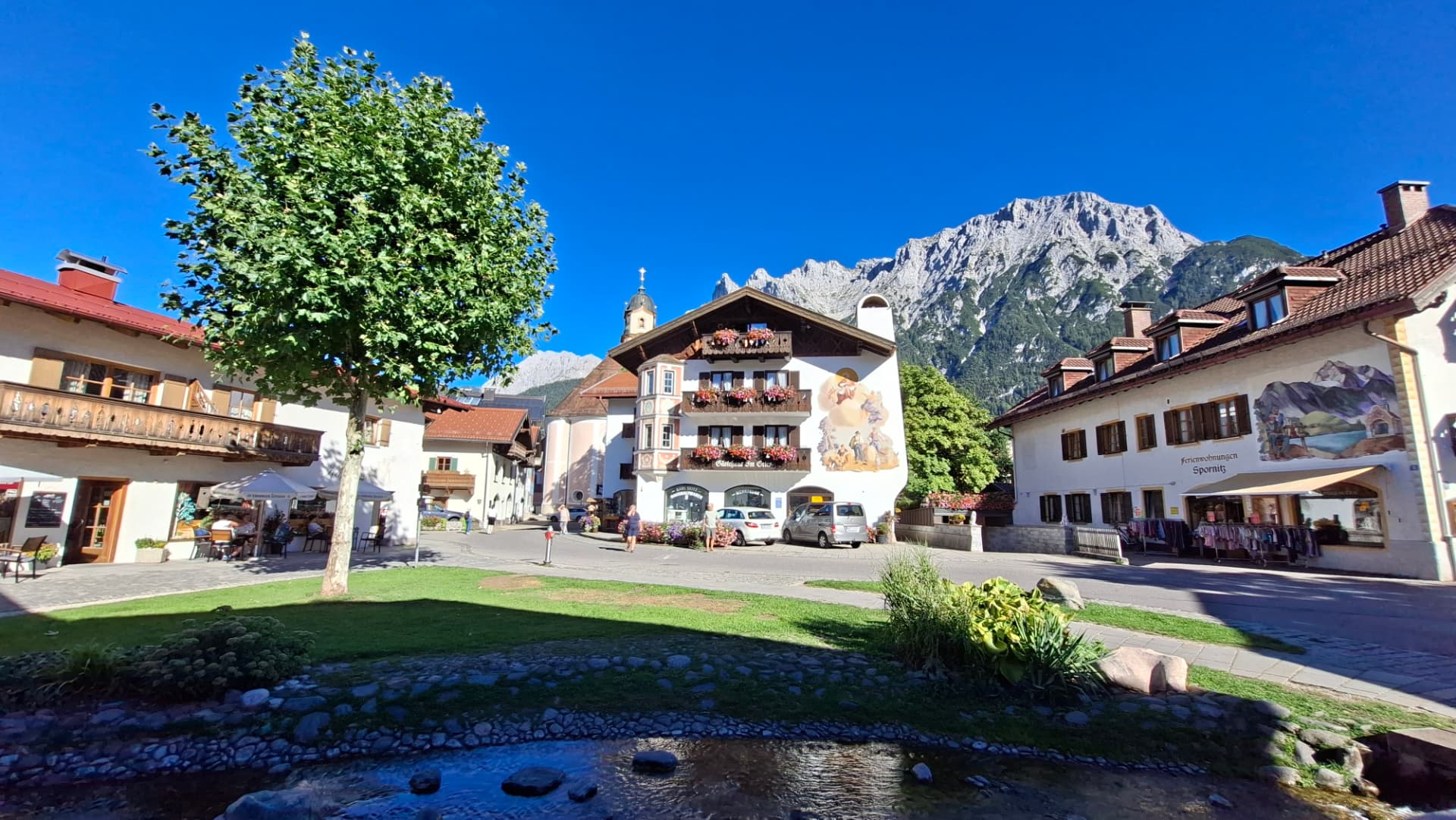
Mittenwald is small enough that "seeing it" sounds like it should take twenty minutes. It doesn't. I walked in from the station toward the center and landed almost immediately in a small park with a fountain and flower beds everywhere — people were cooling off right in the water, kids included, and I slowed down without meaning to.
The church tower is the thing you actually came for, even if you didn't know it. St. Peter and Paul was finished in 1749, and its painted tower — Saints Peter and Paul among the frescoes — is Mittenwald's actual landmark, not a postcard exaggeration. Inside, the frescoes are by the same Augsburg painter (Matthäus Günther) who did half of Bavaria's late-Baroque churches, and the altar is gold enough that "understated" was never the goal. Next to the church there's a small Lourdes grotto in the parish garden, candles burning even on a Tuesday afternoon — the kind of quiet corner you'd walk past in a bigger town.
The stream, the facades, and a hardware store under painted angels
One street over, a stretch of the old Mühlbach stream is running open again — mid-renovation, water visible right under the pavement, somewhere between civic pride and the most photogenic construction site in Bavaria. Past it, the pedestrian zone — terraces, Lüftlmalerei-painted facades, actual historic buildings rather than reproductions — felt less staged than most postcard villages. One building even has angels drifting through painted clouds above the doorway, and directly underneath, at street level: Karl Seitz Haushaltswaren, a hardware store doing steady business in drill bits and garden rakes, sharing a wall with the baroque and not making a fuss about it. That's Mittenwald in one frame — nobody's polishing this place for tourists, it's just where people buy their screws. I didn't have time for an actual Mittenwald beer here, which I regret; the Radler from Edeka later doesn't count.
Where Mittenwald actually comes from
Walk through the parish garden and you land on the square that explains why Mittenwald is on the map at all: the Geigenbaumuseum. Violin-making here goes back to 1684, when Matthias Klotz came home from an apprenticeship in Padua and figured out Mittenwald had everything he needed — no guild restrictions, trade routes to Venice, and Alpine spruce that makes better violins than anything else growing nearby. Leopold Mozart was complaining by 1764 that Paris and London were "full of Mittenwald violins." The violin-making school founded here in 1858 is still running, admitting twelve students a year out of dozens of applicants from around the world.
I got in at 4:15 — closing's at 5, so the reduced ticket (€4.50 instead of €5.50) applied. Twenty-five minutes was enough for me; budget longer if you actually read the display panels. There's a woman actually building violins in a small workshop inside — not a demonstration for tourists, a real workbench — plus a second floor I almost missed. Outside again around 5, the low sun cut across the painted facades on the square at an angle that made the whole thing look better than any photo I took of it.
Back to the station
On the way back I got stopped by an ice-cream queue in the center — worth it, mango and lemon, about €1.90 a scoop. Near the station there's a bike rental with free public toilets out front, useful to know at 5pm with a train to catch. The station itself was already locked by then, kiosk included — which is what sent me on the Edeka detour from the hook. The train back was fine, just twenty minutes late, and already half full from Austria before it even reached Mittenwald.
Photos from the day
All shot by me on the visit. Swipe through.
First few steps into town — arrival square
1 / 16Useful links
- Deutsche Bahn — check times and book the Munich → Mittenwald train
- Geigenbaumuseum — tickets and opening hours
- Alpenwelt Karwendel — events and general info for Mittenwald
- Sports Max Rieger (Mittenwald) — bike, e-bike & ski rental near the station
- St. Peter und Paul — history and opening hours of the painted church tower
Worth the hype? Yes
Yes — but budget more time than you think. I did Mittenwald as the back half of a Karwendelbahn day and it still felt rushed by the end. If you can, give it a full day: the village center is worth two unhurried hours on its own, and there's enough around it (the Karwendelbahn, several lakes, other trailheads) to fill a whole day without repeating yourself.
Haki alternative: If you're only passing through, skip the ice-cream queue and spend those twenty minutes in the Geigenbaumuseum instead — the workshop is the one thing here you can't get anywhere else in Bavaria.
Take it with you
Same day-itinerary PDF as the Karwendelbahn & Mittenwald guide — it covers this route too.
Quick facts
- Region
- The Alps & Zugspitze
- Access
- About 2 h by train from München Hbf to Mittenwald
- Distance
- 100 km from Munich
- Cost
- €
- Best months
- May – October
- Crowds
- medium crowds (my assessment)
Where it is
Mittenwald, Bavaria
Flat, paved streets throughout — no hiking, stroller/wheelchair friendly. Best time: late afternoon, when the low sun lights up the painted facades. Time needed: half a day to see the center properly; a full day if you add a nearby trail or lake. Cost: free to walk the village; Geigenbaumuseum €5.50 full / €4.50 reduced.
Weather
Full forecastHaki Score
8.8More in The Alps & Zugspitze
Karwendelbahn: Germany's Highest Cable Car, Its Own Brewery, and a Trail Full of Sheep
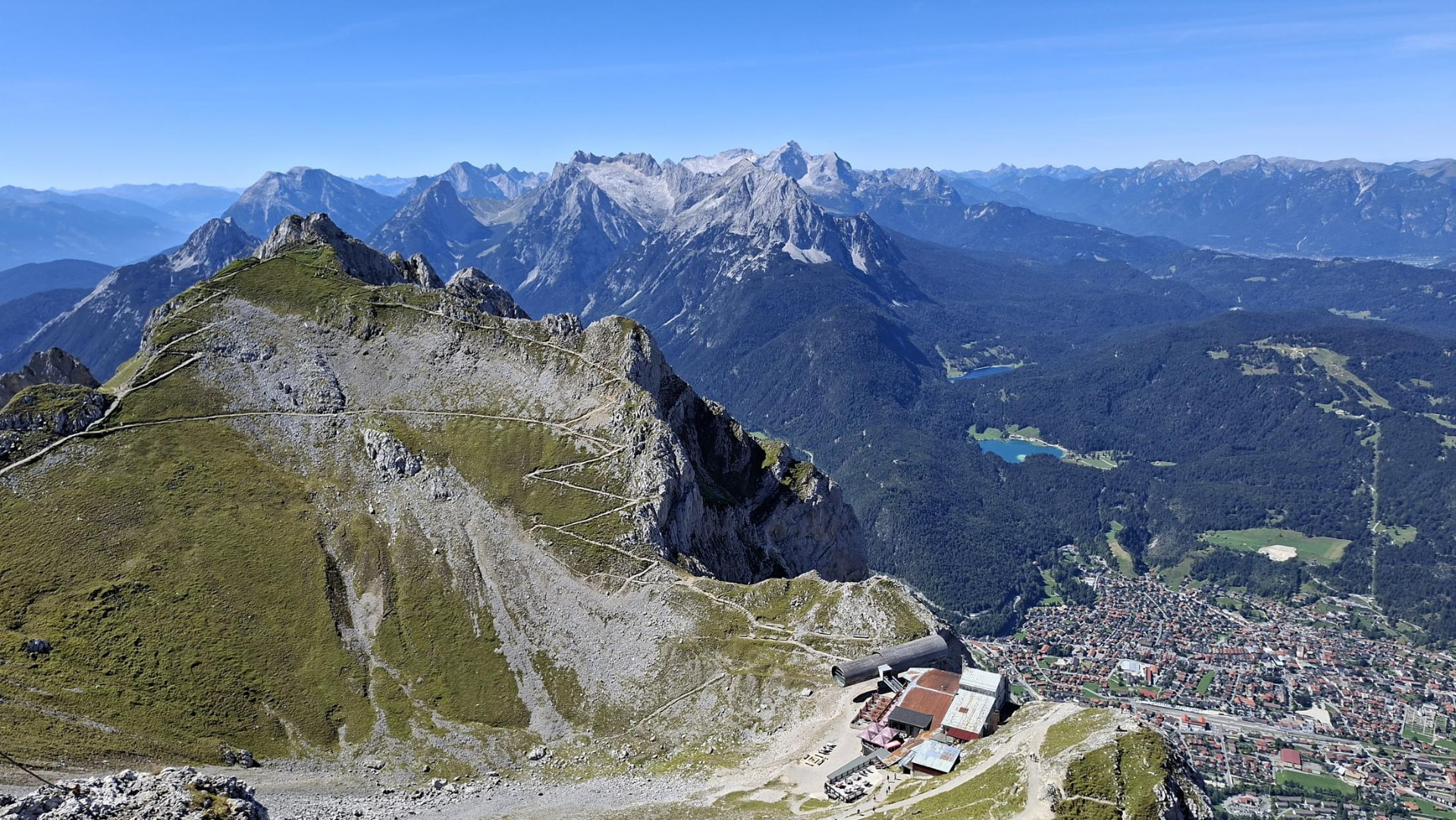
The first time I rode up the Karwendelbahn, fog swallowed the summit whole — I could hear the wind and not much else. This time I waited for a clear forecast instead, and it turned out patience was the only thing I'd been missing. From the top terrace, the Wetterstein range lines up on one side and the Austrian Karwendel on the other, and somewhere in between, a herd of sheep has the best view in Bavaria and doesn't care who knows it.
Rotwand from Spitzingsee: Up on Foot, Down by Cable Car, and a Käsespätzle in Between
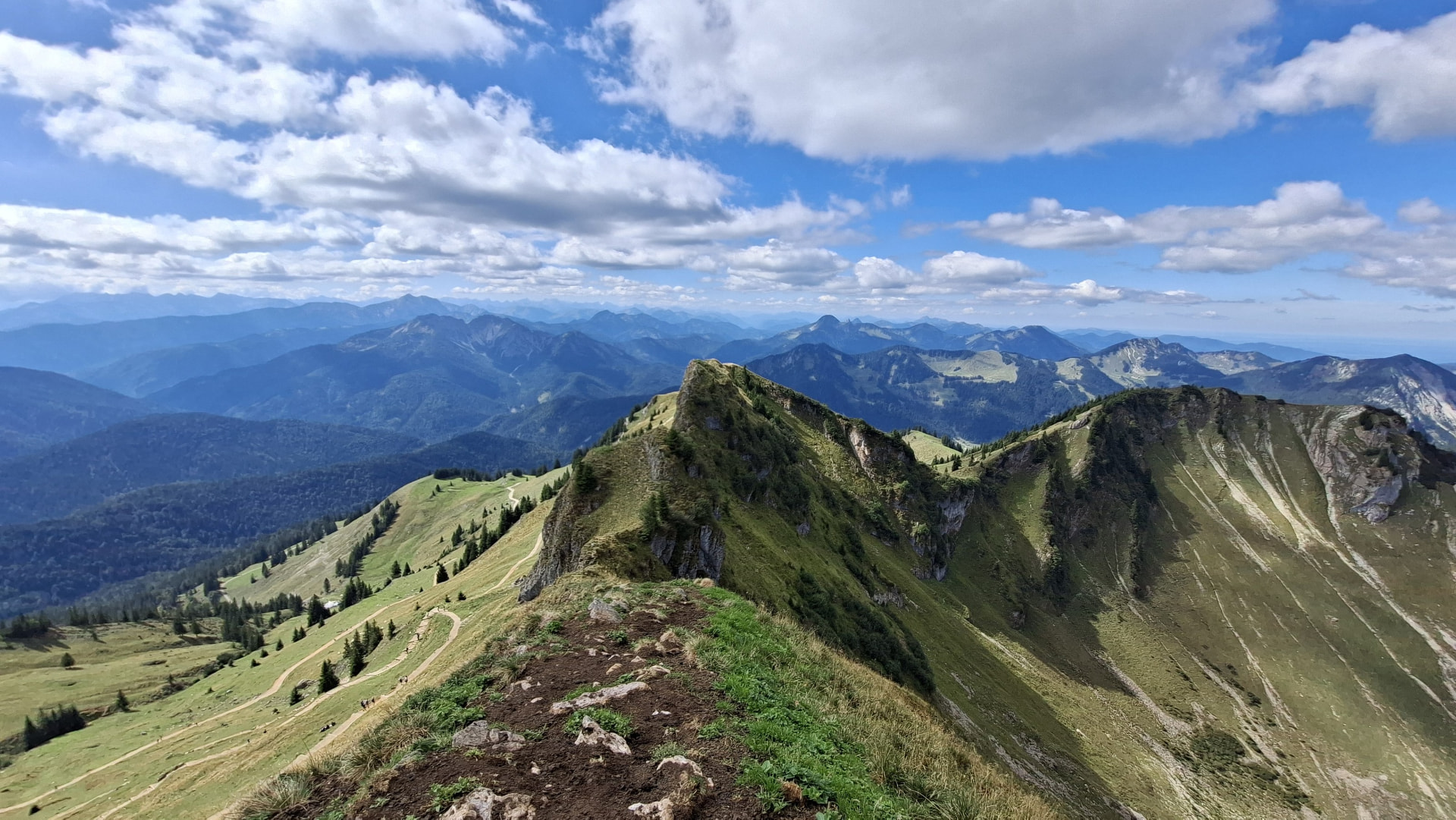
The sign at the trailhead doesn't waste words: alpine experience, sure-footedness, and a head for heights required. I read it, shrugged, and kept walking — and by the time I was holding a steel cable over slick rock below Taubenstein, with families ahead of me deciding whether to turn back, I understood why the German Alpine Club bothers putting signs like that up at all. The ridge past it, all the way to Rotwand's 1,884 m summit, is the reason to come. The Käsespätzle and the cable car down are the reason it doesn't hurt to stay a while first.
Wendelstein: A Real Alpine Hike, One Train Ride from Munich
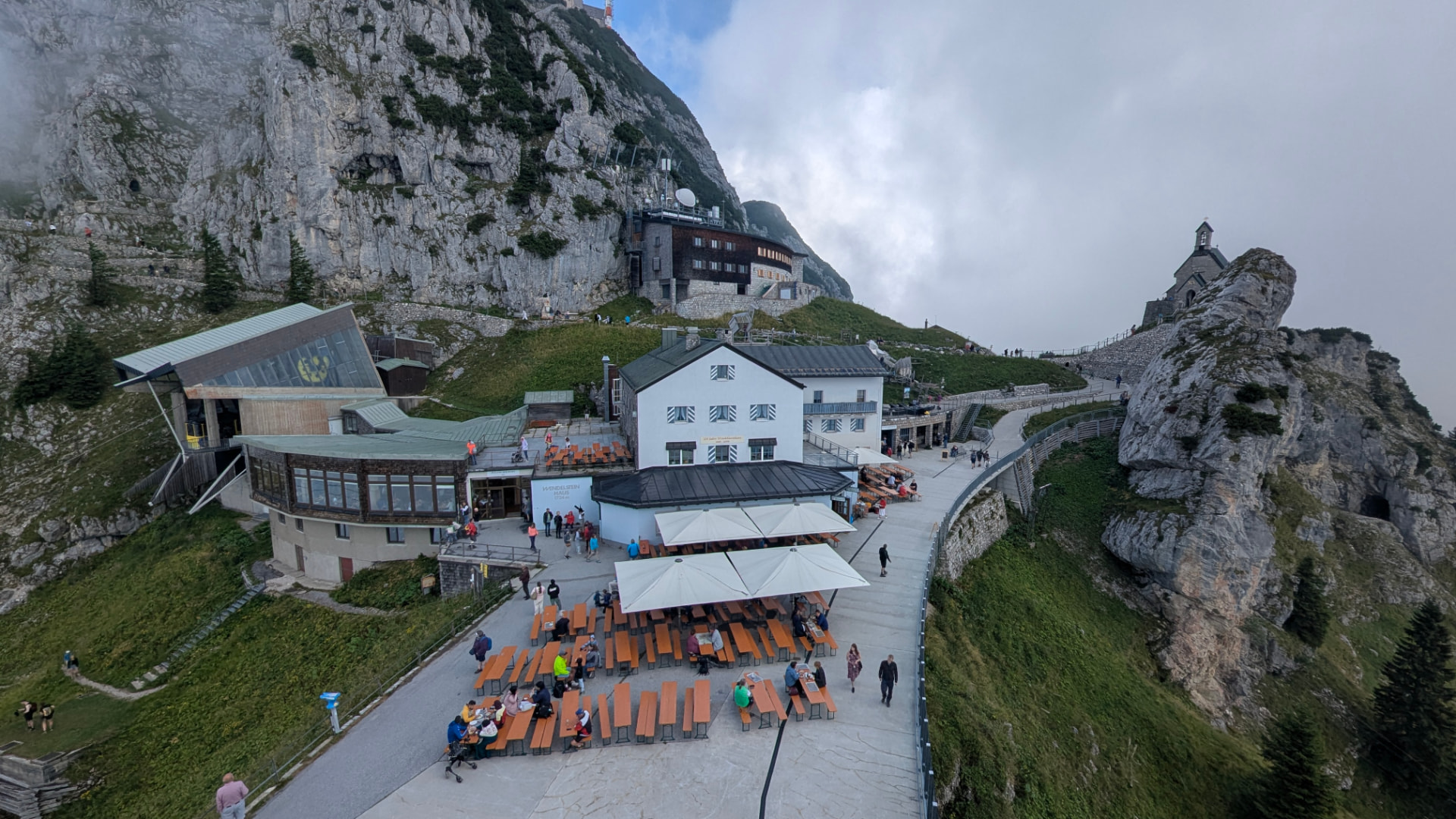
I climbed Wendelstein expecting a quiet alpine trail and found a mountain with its own church, cave, restaurant terrace, and university observatory waiting at the top — plus a cable car and a 114-year-old rack railway — the oldest still-working one in Bavaria — in case my legs gave out first. They didn't, but it was close: the official signs say 3.5 hours up, and I did it in 2.5.
New trips, straight to your inbox
No spam. Just the routes, how to get there by train, and the best time to go.
By subscribing, you agree to receive the Haki Travels newsletter. We'll send you one email to confirm your subscription, and you can unsubscribe at any time. Privacy Policy