Must-See Bavaria · Salzburg, Austria
Salzburg from Munich on a Bayern-Ticket: A Day Trip by Train
Personally visited by Martin · 18 September 2023
Two hours by regional train, one ticket you may already have, and you are in another country. How I plan a day trip from Munich to Salzburg, and what to pack.
From Munich, Salzburg is about two hours away by regional train. It is close enough for a day trip, yet you still cross into another country on the way. The best part is that you may not need another ticket, because the Bayern-Ticket already takes you all the way to Salzburg's main station.
I have done this trip more than once, in summer and in early autumn. Here is how I get there, the one thing I always pack, and what I would not skip once I am in the old town.
A note on the dates: my photos are from July 2022 and September 2023, so check opening times and prices on the official links at the end before you go.
Getting there on the Bayern-Ticket
The train you want is the RE 5, a regional express that runs from Munich Hauptbahnhof to Salzburg Hauptbahnhof about every hour. The ride takes roughly two hours.
Because it is a regional train, your Bayern-Ticket is valid for the whole journey, including the stretch across the border. The Deutschland-Ticket works too. You do not need a separate Munich to Salzburg ticket, and if you travel with other people, the whole group travels on one Bayern-Ticket, which is where it really pays off. How the group price works, and where the ticket is and is not valid, is all in my guide to the Bayern-Ticket.
One thing to keep in mind: on weekdays the Bayern-Ticket is only valid from 9:00, on weekends it is valid from midnight. If you go on a weekday, plan to leave after 9:00.
Most people board at the Hauptbahnhof. The RE 5 also stops at München Ost, so if you are staying near the Ostbahnhof you can get on there and skip the ride into the centre. Check your exact connection in the DB Navigator app, because construction work can change which stops the train makes. If you are still choosing where to stay, my guide to where to stay in Munich for day trips by train covers that.
Haki tip: I like to be on the platform about 20 minutes before departure, especially on weekends, when the trains to Salzburg can get busy.
The ticket is valid as far as Salzburg Hauptbahnhof. From there I walked into the old town, an easy walk. The ticket does not cover Salzburg's city buses, so if you would rather take the bus, you will need a separate ticket. Prices change, so I am not quoting any here. For tickets in Munich itself, see getting around Munich.
Bring your ID
Germany checks its borders, including on trains coming in from Austria. At the first stop on the German side, Freilassing, federal police sometimes board the train and check IDs. So carry your original passport or ID card. A photocopy is not enough, and neither is a photo on your phone. If you are not an EU citizen, bring your passport and any required permits, and print a copy of anything you only have stored on your phone, in case the battery dies or the signal drops.
The rules can change, so check the current requirements before you go. There is a link at the end.
Haki tip: do not leave your return journey until the last train of the night. The RE 5 runs hourly, so if you miss one, you wait another hour, and a document check can add a few minutes.
Into the old town
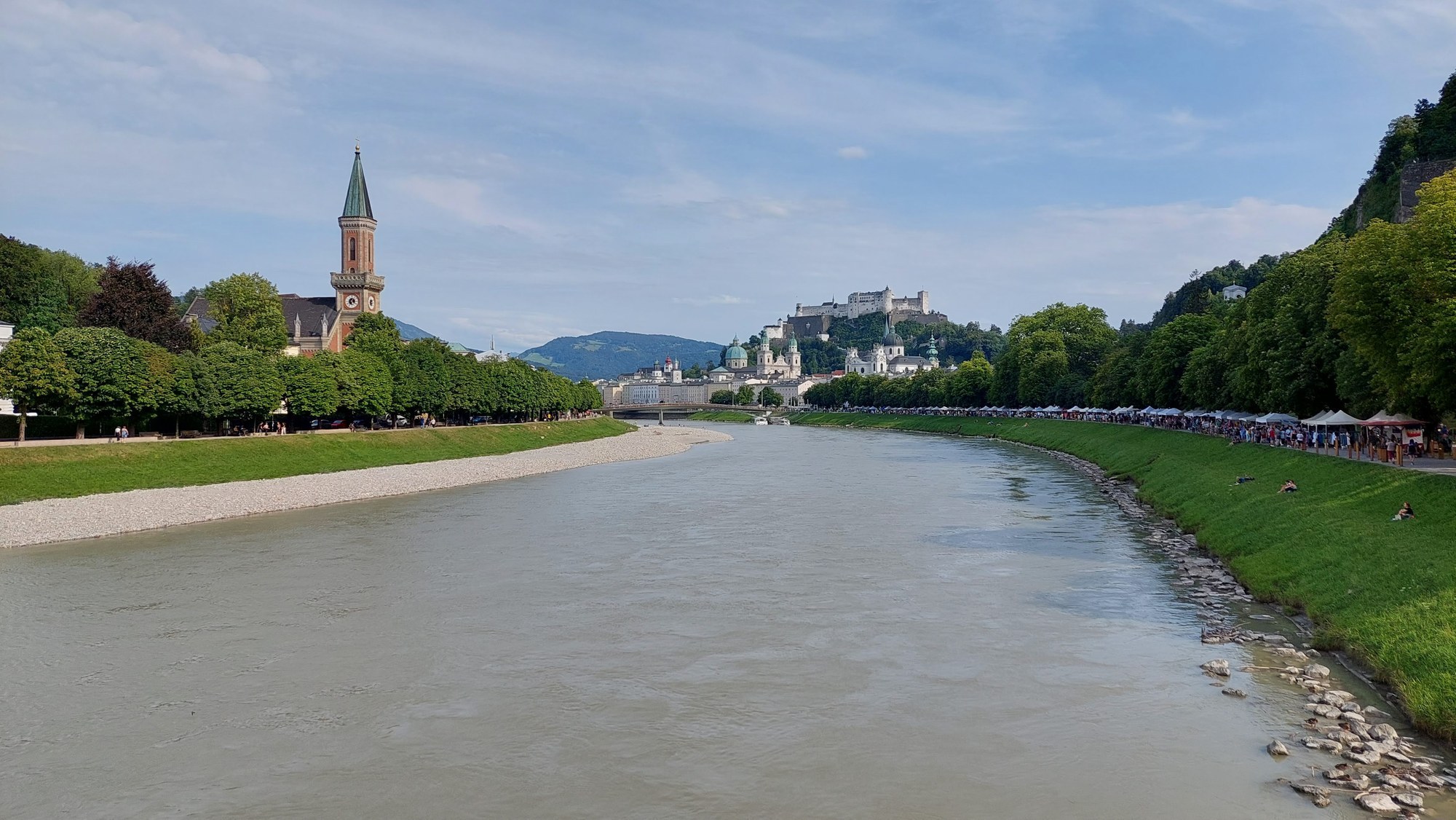
Salzburg's old town is a UNESCO World Heritage site, and it is compact enough to see most of it on foot in a day. The Salzach river runs through the middle, with the old town on one bank and the newer streets on the other, and the fortress high above the city.
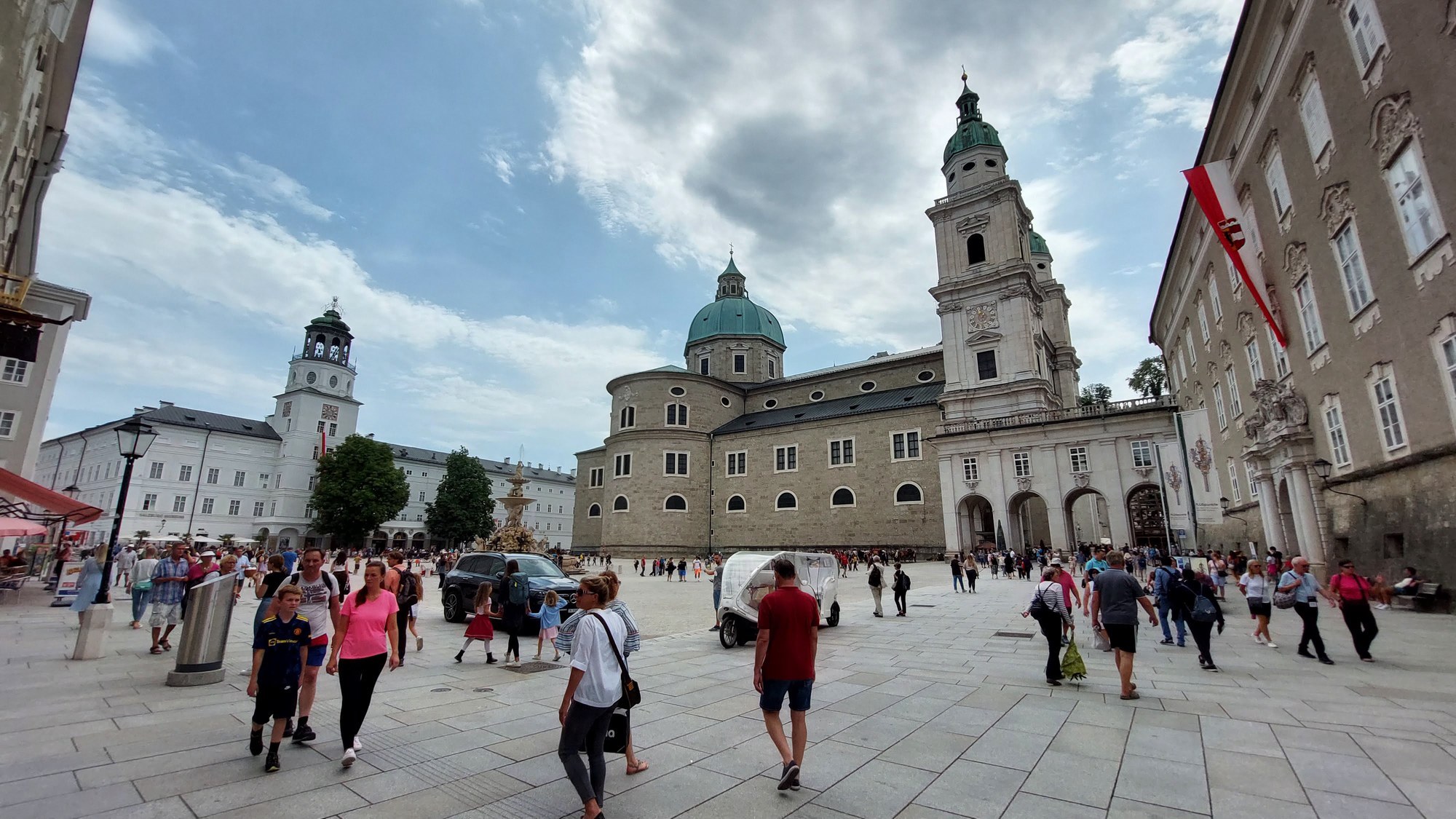
The old town owes its look to the prince-archbishops, who ruled Salzburg as a small church state for centuries. The city grew rich on salt (the name comes from the salt barges on the Salzach), and in the 17th century the archbishops rebuilt the centre in the Baroque style you see today. In 1996 the old town was added to the UNESCO World Heritage list.
I spent my time wandering the old town streets and walking through the gardens and parks. The cathedral was under renovation when I was there, so I could not go in. If the cathedral matters to you, check whether it is open before you go.
The fortress, and where to see it from
Hohensalzburg Fortress sits on the hill above the old town. Archbishop Gebhard began building it in 1077, his successors kept expanding it, and by around 1500 it looked much as it does today. It was built to protect the archbishops, and according to the Salzburg tourist board it was never captured by foreign troops. Today it is one of the biggest fully preserved castles in Central Europe.
I went up, and it was well worth it: the view takes in the whole city and the mountains around it. Entry to the fortress costs extra. There are several ticket options, with or without the funicular railway, and the opening hours change with the season, so check the current ticket options and opening hours on the official fortress pages linked at the end.
I also walked to the other side of the river. From there you can see the entire fortress above the rooftops, and it is much easier to understand how big it really is.
Mozart and the Mozartkugel
Mozart was born in Salzburg in 1756, at Getreidegasse 9, and the city has not let anyone forget it. His name shows up on everything from concert posters to chocolate. The house where he was born is now a museum, Mozart's Birthplace, and the museum says a visit takes about an hour. Mozart died in Vienna in 1791, but in Salzburg he is still everywhere. Opening hours and ticket prices are on the museum's website, linked at the end.
And then there is the chocolate. The Mozartkugel was invented around 1890 by the Salzburg confectioner Paul Fürst, who first called it a Mozart-Bonbon. It is a ball of pistachio marzipan wrapped in nougat and dipped in dark chocolate. Imitations soon followed, and today you will see several brands in the shop windows. The Original Salzburger Mozartkugel from Fürst is the one in silver foil with a blue Mozart portrait, and Fürst sells it in its own shops in the old town. It is made without preservatives and keeps for only about eight weeks, so it is a souvenir to enjoy over the next few weeks, not one to keep until next year.
If you just want some Mozartkugeln to take home, here is a tip: in my experience the best prices are at SPAR, a supermarket chain you will often find at train stations. There is one right at Salzburg Hauptbahnhof, so you can pick them up on the way back to your train. Everywhere else I found them clearly overpriced. If you want the original, buy it from Fürst, as described above.
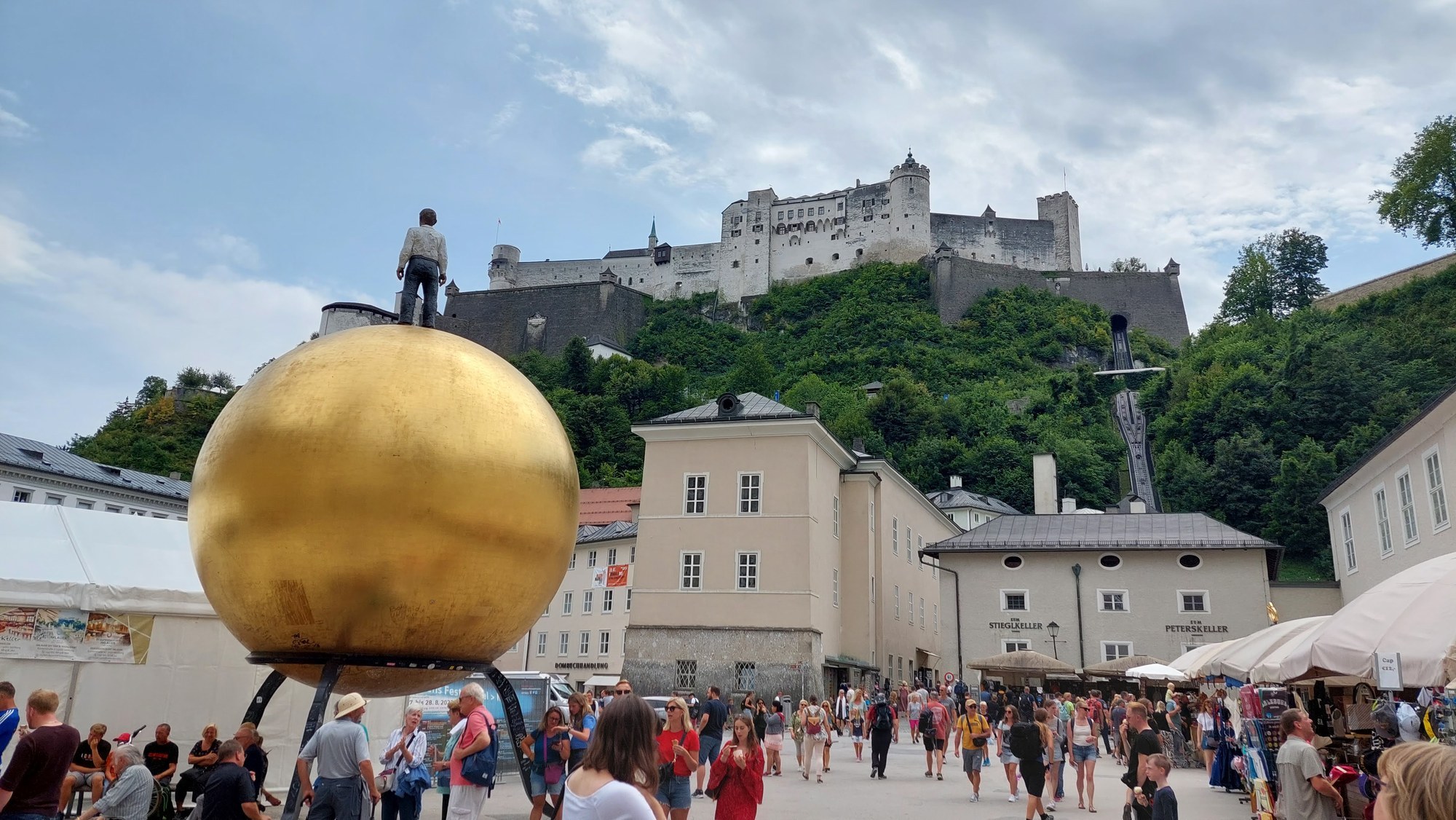
On Kapitelplatz, below the fortress, a big golden sphere with a man standing on top catches your eye. It is a sculpture called Sphaera by the German artist Stephan Balkenhol, and I like to think of it as a giant Mozartkugel. It is also where I took the photo at the top of this page.
Leberknödel at Zwettler's Wirtshaus
I love Leberknödel. These are liver dumplings: minced liver mixed with soaked bread roll, egg, onion and herbs, shaped into balls, then either simmered in broth or fried, and served in a clear soup or with sauerkraut. I order them every time I am in Salzburg, and the place I would recommend is Zwettler's Wirtshaus, a traditional Austrian restaurant at Kaigasse 3, in the old town. It has about 4.5 stars on Google from more than 7,000 reviews.
On their menu the dumplings are called gebackene Leberknödel. Gebacken here means fried in hot fat rather than simmered in broth, which gives them a crisp crust. You can have them in the soup instead of noodles, or as a main course on sauerkraut. The menu describes it as Mozart's favourite dish.
It is popular, so try to arrive a little before the lunch rush. If liver is not for you, there is plenty of classic Austrian food on the menu. Check the current opening hours on their website before you go.
Weather and when to go
One of my visits was bright and sunny, the other was cloudy, and the photos show both kinds of weather and were taken in July 2022 and September 2023. That way you can see the city in bright sunshine and under cloudy skies. Salzburg sits at the edge of the Alps, and the weather can change during the day, so I would pack a light rain jacket. My visits were in summer and early autumn, and that is when I would go again. For the bigger picture across Bavaria, see when to visit Bavaria.
I visited Salzburg on day trips, and you can see the main sights in one day. If you want to go slower, staying overnight in Salzburg is also a good option.
Want to plan a longer day in Munich first? My guide to one day in Munich has a route you can use before or after.
- Do I need a special ticket for the trip to Austria?
- No. The Bayern-Ticket and the Deutschland-Ticket both are valid on regional trains all the way to Salzburg Hauptbahnhof, so you can ride the RE 5 on the ticket you may already have.
- Is the Bayern-Ticket valid on Salzburg's city buses?
- No. It is valid on regional trains up to Salzburg Hauptbahnhof, but not in Salzburg's local transport.
- Can I go to Salzburg with the Deutschland-Ticket?
- Yes. Deutsche Bahn lists Salzburg among the stations on the border where the Deutschland-Ticket is valid. It is not valid on Salzburg's city transport either.
- Do I need my passport?
- Bring your passport or ID card. Germany checks its borders, and federal police sometimes board trains from Austria. Bring the original document, not a photocopy or a photo on your phone.
- How often does the train run, and how long does it take?
- The RE 5 runs about every hour, and the ride takes roughly two hours each way.
- Is Hohensalzburg Fortress open all year?
- Yes, the fortress is open all year, but the hours change with the season, and there are occasional short closures. Check the official opening hours and tickets before you go.
- Can I visit Mozart's Birthplace?
- Yes. Mozart was born at Getreidegasse 9, and the house is now a museum. A visit takes about an hour. Check the opening hours and ticket prices on the museum's website.
- Where can I buy an original Mozartkugel?
- The Original Salzburger Mozartkugel comes from the Fürst confectionery, which has shops in the old town. Look for the silver foil with the blue Mozart portrait. It keeps for about eight weeks.
- Where are Mozartkugeln cheapest?
- In my experience at SPAR supermarkets, for example the one at Salzburg Hauptbahnhof. In the old town they cost clearly more. For the original, go to Fürst.
- Is one day enough for Salzburg?
- For the main highlights, yes: the old town, the fortress, the river and the gardens. If you want a slower pace, stay overnight.
Photos from my visits
I took all of them during my visits in July 2022 and September 2023. Swipe through.
Water jets in the pavement and a red trolleybus on a busy square in central Salzburg.
1 / 22Useful links
- Deutsche Bahn journey planner — plan your route
- Bayern-Ticket — regional day ticket
- Deutschland-Ticket — flat monthly ticket
- Border controls (Deutsche Bahn) — check before you travel
- Salzburg tourism — official city tourism site
- Hohensalzburg Fortress, opening hours — check before you go
- Hohensalzburg Fortress, tickets and prices — with or without the funicular
- Mozart's Birthplace, opening hours and prices — official museum page
- Fürst, the Original Salzburger Mozartkugel — history and shops
- SPAR Salzburg Hauptbahnhof — supermarket at the station, opening hours, in German
- Zwettler's Wirtshaus — opening hours
Quick facts
- From Munich
- ~2 h by regional train (RE 5, about every hour)
- Getting into town
- easy walk from the station (city buses need a separate ticket)
- Ticket
- Bayern-Ticket (weekdays from 9:00) or Deutschland-Ticket, valid to Salzburg Hbf
- Bring
- passport or ID card (the original)
- Best season
- summer to early autumn (when I went)
- Budget
- old town is free to walk · fortress and museums charge admission · cheapest Mozartkugeln at SPAR
- Signature taste
- gebackene Leberknödel at Zwettler's · Mozartkugel
Where it is
Salzburg, Austria
Weather
Full forecastSalzburg day at a glance
- Distance
- ~9–10 km on foot (station, old town, fortress and back; my estimate)
- Time on the ground
- about 7 hours (I was there from 11:00 to 18:00)
- Walking time
- ~3–4 hours, the rest went on the fortress, food and breaks
- Elevation gain
- ~100–150 m (the climb up to the fortress; almost none with the funicular)
- Terrain
- flat, cobbled old town and one steady climb to the fortress
More in Salzburg, Austria
Karwendelbahn: Germany's Second-Highest Cable Car, Its Own Brewery, and a Trail Full of Sheep
The first time I rode up the Karwendelbahn, fog swallowed the summit whole — I could hear the wind and not much else. This time I waited for a clear forecast instead, and it turned out patience was the only thing I'd been missing. From the top terrace, the Wetterstein range lines up on one side and the Austrian Karwendel on the other, and somewhere in between, a herd of sheep has the best view in Bavaria and doesn't care who knows it.
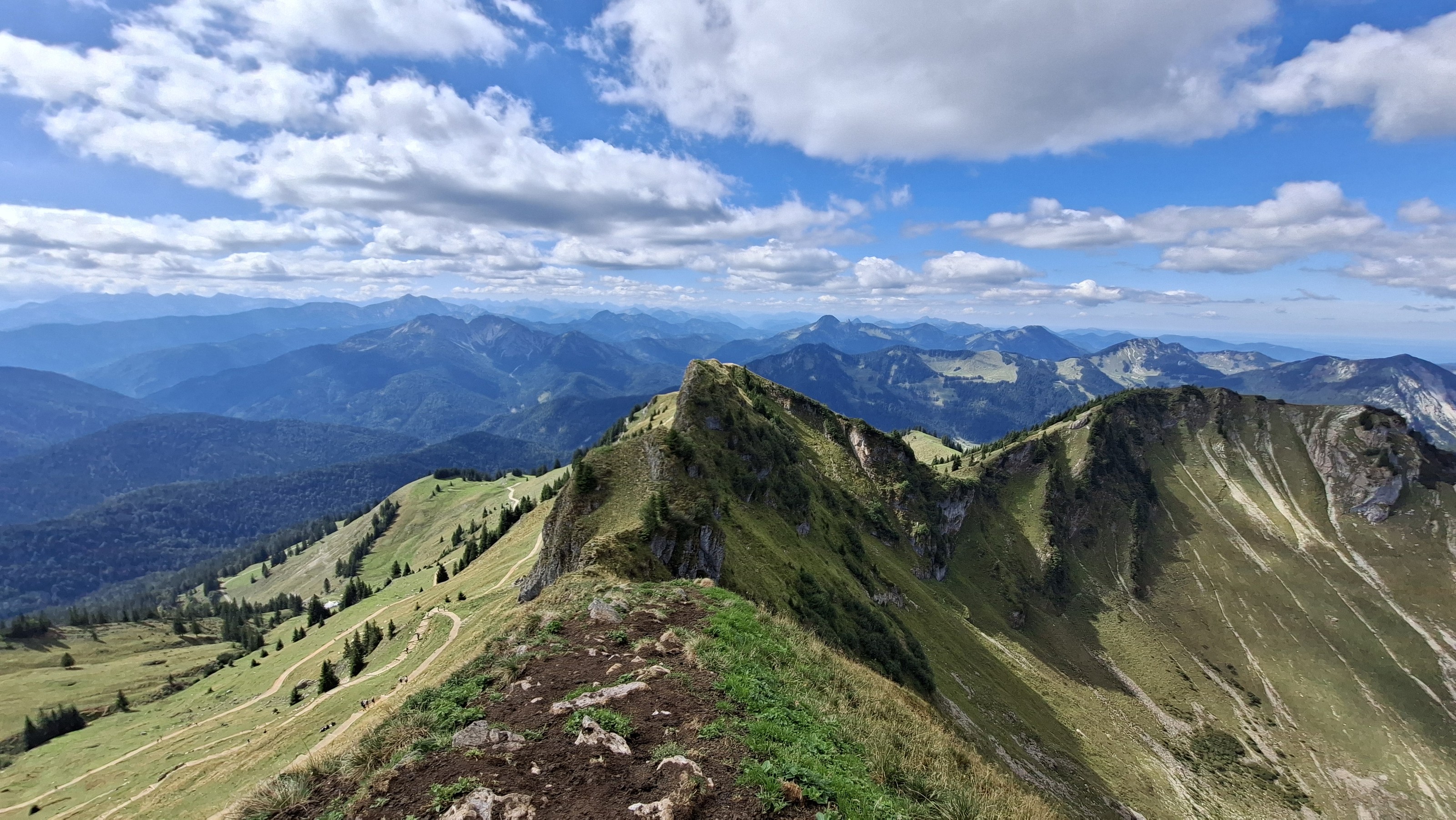
Rotwand from Spitzingsee: Up on Foot, Down by Cable Car, and a Käsespätzle in Between
The sign at the trailhead doesn't waste words: alpine experience, sure-footedness, and a head for heights required. I read it, shrugged, and kept walking. By the time I was holding a steel cable over slick rock below Taubenstein, with families ahead of me deciding whether to turn back, I understood why the German Alpine Club bothers putting signs like that up at all. The ridge past it, all the way to Rotwand's 1,884 m summit, is the reason to come. The Käsespätzle and the cable car down are the reason it doesn't hurt to stay a while first.
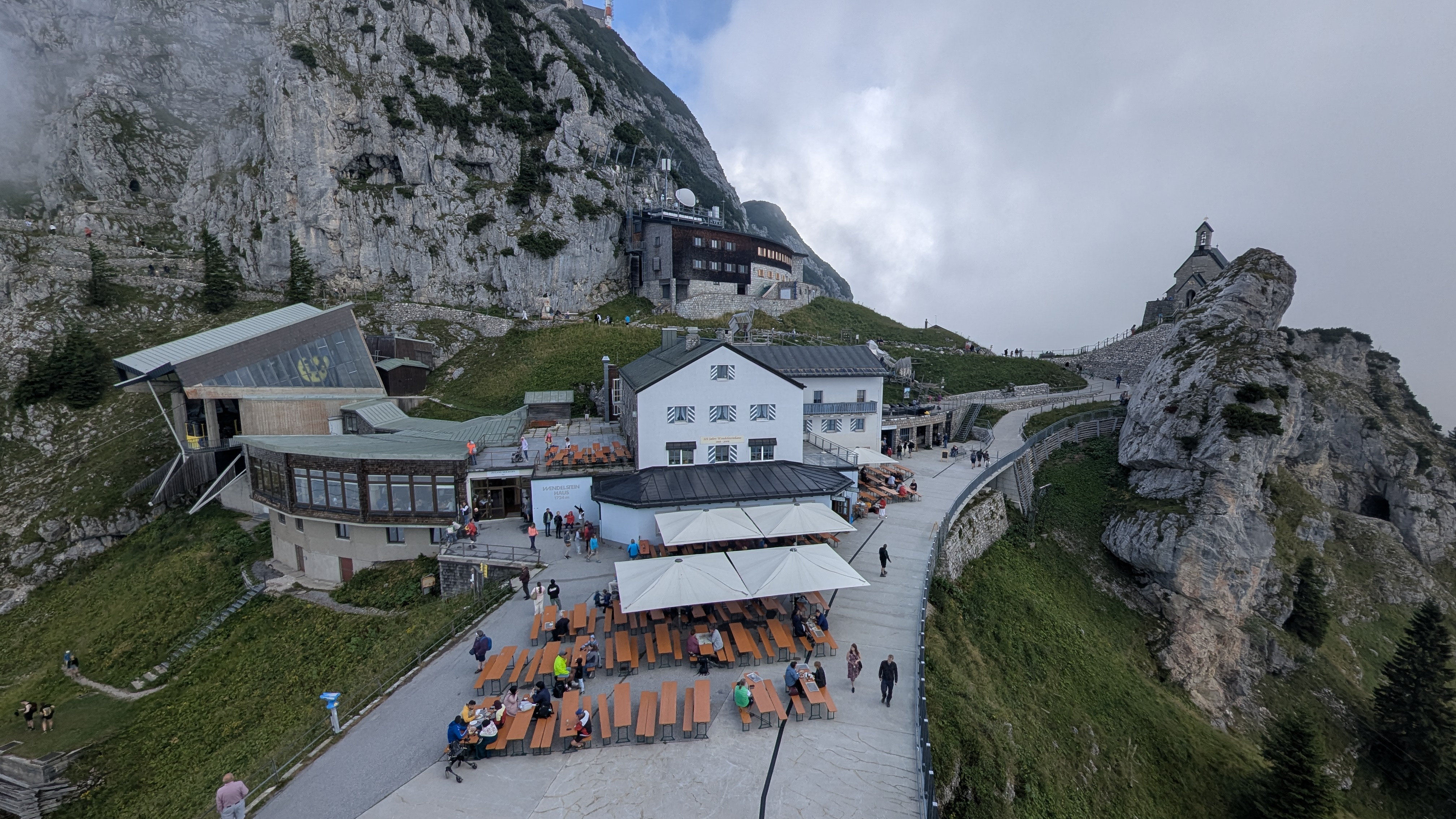
Wendelstein: A Real Alpine Hike, One Train Ride from Munich
I climbed Wendelstein expecting a quiet alpine trail and found a mountain with its own church, cave, restaurant terrace, and university observatory waiting at the top, plus a cable car and a rack railway (opened in 1912, the oldest still running in Bavaria) in case my legs gave out first. They didn't, but it was close: the official signs say 3.5 hours up, and I did it in 2.5.
New trips, straight to your inbox
No spam. Just the routes, how to get there by train, and the best time to go.
By subscribing, you agree to receive the Haki Travels newsletter. We'll send you one email to confirm your subscription, and you can unsubscribe at any time. Privacy Policy